Before you go
What to wear, what to pack, and what to know.
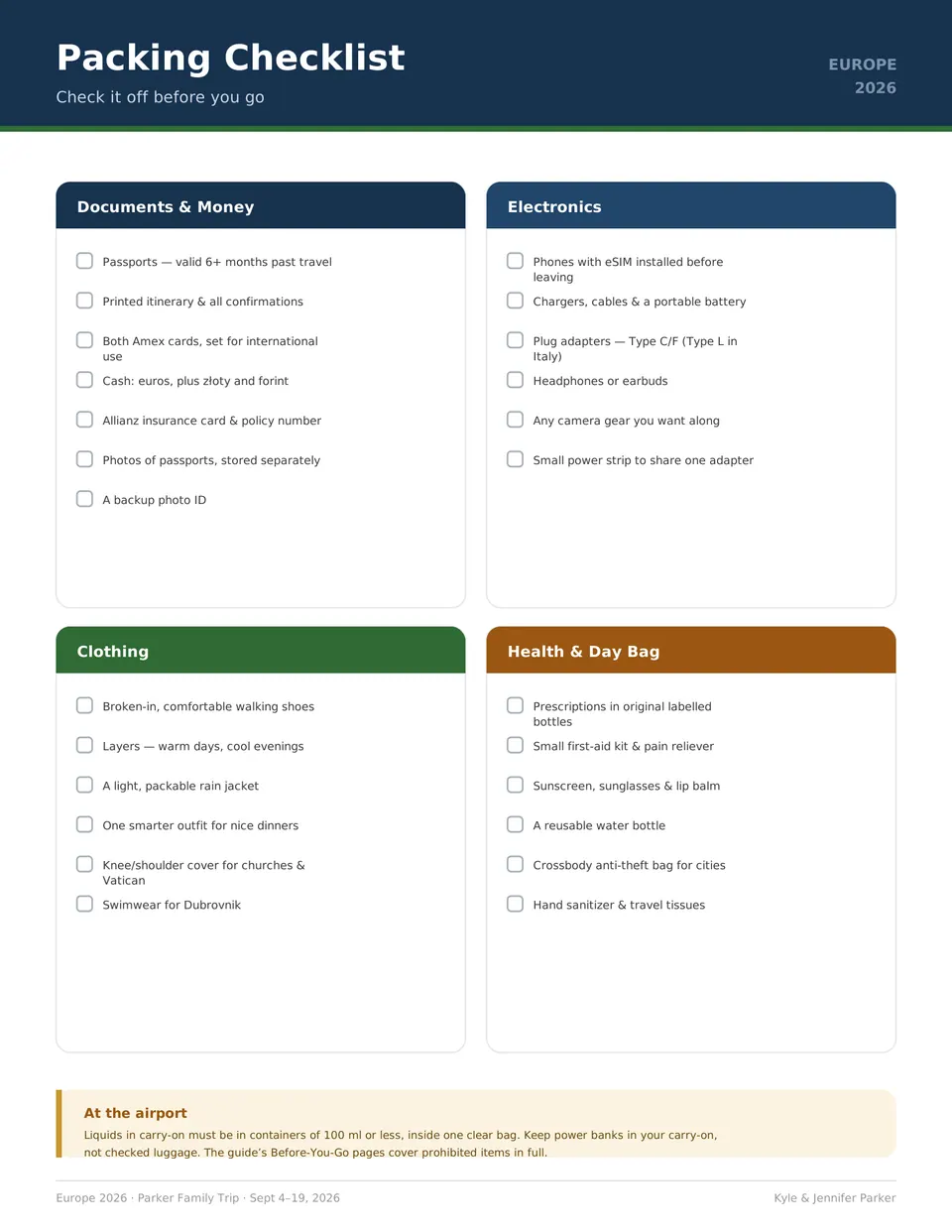
What to wear
- Footwear: Comfortable, broken-in walking shoes are the most important thing you pack — every city has cobblestones, hills, or long walks, and the Salt Mine alone is about 800 steps.
- Layers: Dress in layers — short sleeves for daytime, a light jacket or sweater for evenings. The Wieliczka Salt Mine stays around the mid-50s°F underground, so carry a layer even on a warm day.
- Churches: Shoulders and knees must be covered to enter churches and basilicas. This is strictly enforced at the Vatican (St. Peter's and the Sistine Chapel) and St. Mark's in Venice, and applies at Matthias Church, St. Mary's Basilica, the Florence Duomo and others. Carry a scarf or shawl.
- Auschwitz: Dress respectfully and for the weather; much of the visit is outdoors and can be cool or wet.
- Dinners: Several dinners are at smart, Michelin-level restaurants (Borkonyha, and others you may book). Pack one smart-casual outfit each — a collared shirt, no athletic wear.
- Sun & heat: Dubrovnik's City Walls and Mount Srđ, Pompeii, and the Italy days are hot and sun-exposed — a hat and sunglasses make a real difference.
What to pack
- Passports — valid well beyond September 2026 — plus a photo or copy of each stored separately.
- Both Amex cards (no foreign-transaction fee) and a backup card; some euros in cash, and coins for public restrooms, especially in Poland.
- A European plug adapter (Type C / F, 230V) and a power bank for long sightseeing days. Keep the power bank in your carry-on.
- A light, packable rain jacket or a compact umbrella — useful in Amsterdam in particular.
- A scarf or shawl for church dress codes; it doubles as an evening layer.
- A small day bag or crossbody — large bags are turned away at Auschwitz and several museums.
- A refillable water bottle for the long walking days — the City Walls, Pompeii, the Salt Mine.
- Sunscreen, sunglasses, and a hat for Dubrovnik, Pompeii, and Italy.
- Medications in their original packaging, plus a small blister-and-first-aid kit.
- Printed copies of every confirmation — flights, hotels, trains, and tours. Pompeii tickets are personalized: the name must match your passport exactly.
- Your phone with offline maps downloaded, and an international plan or eSIM set up before you go.
- Earplugs and an eye mask for the overnight flight to Amsterdam.
- Pack light overall — the Italy leg means hauling and storing luggage at train stations.
Airline baggage — read before you pack
- The intra-Europe flights are on KLM, LOT, Wizz Air, and Ryanair. Wizz Air, Ryanair, and LOT enforce strict carry-on size and weight limits and charge high fees at the gate. Check each airline's allowance before the trip and pre-pay online for any checked bags.
- The liquids rule applies to carry-ons on every flight — containers of 100 ml or less in a clear bag. Power banks and spare batteries must travel in carry-on baggage, never checked.
- Online check-in: Ryanair and Wizz Air require you to check in online before reaching the airport and charge a steep fee to do it at the counter — check in as soon as it opens and have mobile or printed boarding passes ready.
Museums & historic sites
- Auschwitz-Birkenau: Large bags and backpacks are not allowed inside — only small bags (roughly 30 x 20 x 10 cm). Behave respectfully and follow the guide's instructions on photography.
- Vatican & St. Peter's: The covered-shoulders-and-knees dress code is enforced and visitors are turned away. Large bags must be checked, photography is not allowed in the Sistine Chapel, and silence is requested inside.
- Colosseum: Large bags, backpacks, and glass bottles are not permitted; expect airport-style security screening.
- Pompeii: Tickets are personalized and photo ID is checked at entry, so names must match exactly. Large luggage is not allowed on site.
- Drones: Drones are prohibited at essentially all of these heritage sites.
City rules & payments
- Venice: Venice fines visitors for sitting on monument steps or bridges, picnicking in St. Mark's Square, feeding pigeons, and swimming in canals. A day-visitor 'access fee' also applies on many 2026 dates — check whether Sept 18 is a fee day.
- Payments: When paying by card abroad, always choose the local currency (EUR, PLN, or HUF) — never USD — and decline 'dynamic currency conversion.'
- Emergencies: In any emergency anywhere in the EU, dial 112 — it is free and works from any phone.
- Hotels: The Hilton Rome Airport is a non-smoking hotel.