Europe 2026
100days to go

Route & overview

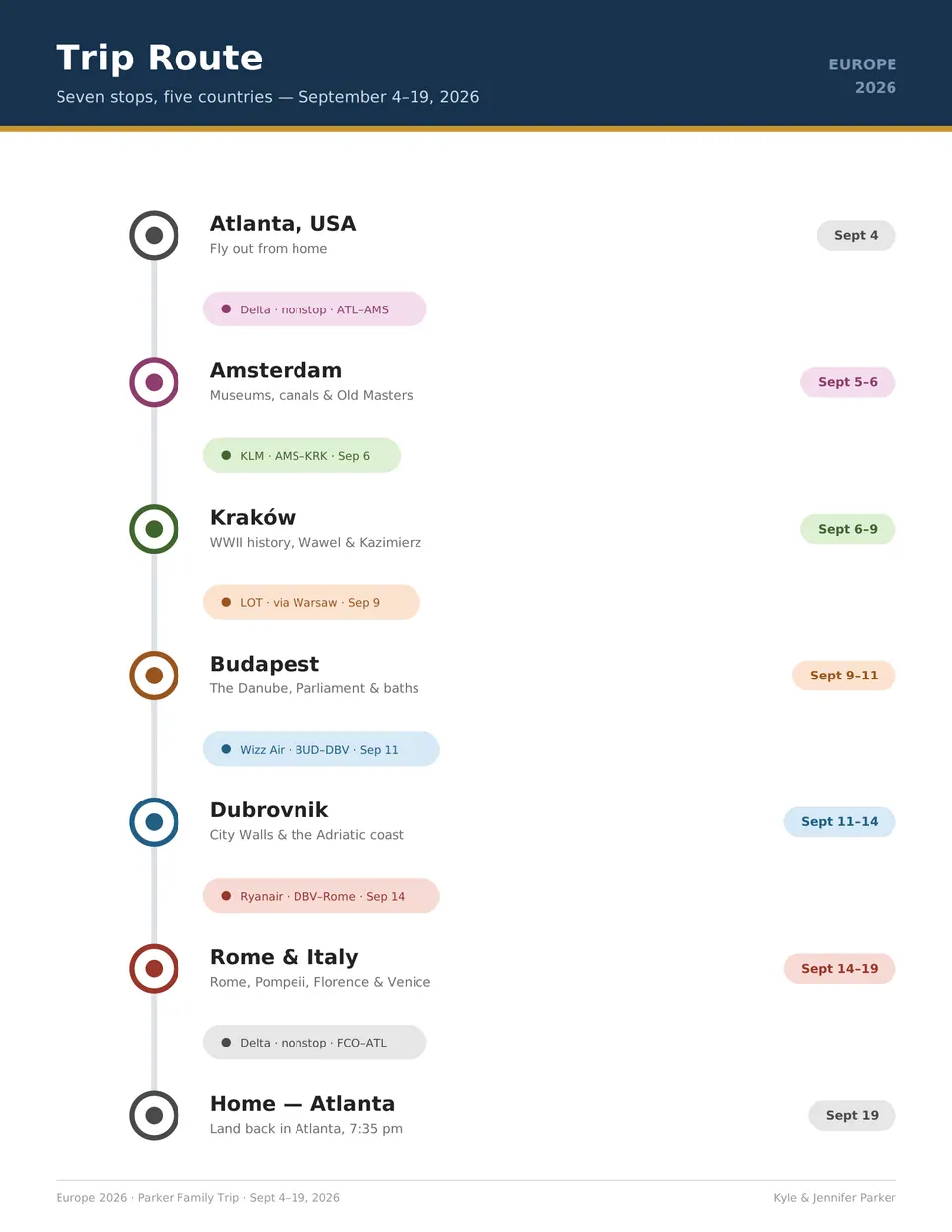
Atlanta → Amsterdam → Kraków → Budapest → Dubrovnik → Rome

Route map: Atlanta → Amsterdam → Kraków → Budapest → Dubrovnik → Rome
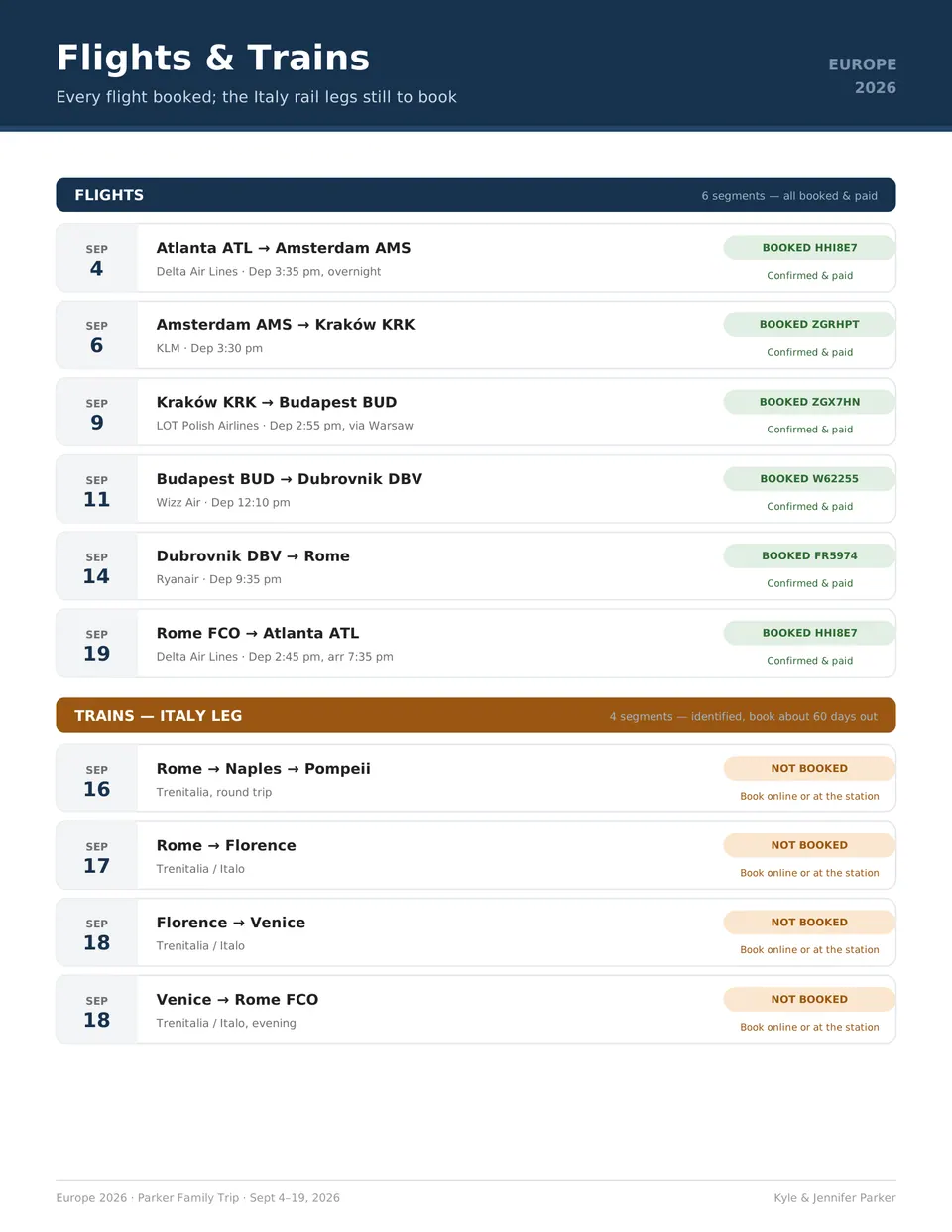
All transport segments at a glance

Sixteen days across five countries — the Netherlands, Poland, Hungary, Croatia, and Italy. One overnight flight out of Atlanta, five flights between European cities, an overland Italy leg by train, and a nonstop flight home. The group travels together as far as Dubrovnik; the Italy portion (Sept 14–19) is just Kyle and Jennifer.

City notes — getting around & more to see

The Netherlands — Amsterdam

Getting around: Compact and very walkable. GVB runs an extensive tram, bus and metro network — trams are the most useful for sightseeing; tap a contactless card or buy a GVB ticket. Both Uber and Bolt operate (Uber has more drivers). Bikes are everywhere, but city cycling suits confident riders.

Your hotel: Dikker & Thijs Hotel Open in Google Maps

Also worth seeing & doing: The Rijksmuseum (Rembrandt and Vermeer), a canal cruise, the Jordaan and the Nine Streets for browsing, Vondelpark, the Albert Cuyp street market, the Begijnhof courtyard, and the Heineken Experience.

Poland — Kraków

Getting around: The Old Town is largely pedestrian and walkable. MPK Kraków runs frequent trams and buses — buy tickets from machines or the app and validate on board. Uber and Bolt both operate and are inexpensive; official taxis too.

Your hotel: AC Hotel by Marriott Kraków Open in Google Maps

Also worth seeing & doing: The Rynek Underground museum beneath the Main Square, St. Florian’s Gate and the Barbican, the leafy Planty park ringing the Old Town, the Podgórze district and ghetto memorial, and a Vistula River cruise. Longer day trip: the Tatra Mountains and Zakopane.

Hungary — Budapest

Getting around: Buda and Pest are linked by bridges. BKK runs an excellent metro (4 lines), trams and buses — scenic Tram 2 follows the Pest riverbank. Bolt is the main ride-hailing app; Uber returned in 2024 but sends a regulated yellow taxi at the metered rate. Use Bolt or a marked Főtaxi and avoid unmarked taxis.

Your hotel: Courtyard by Marriott Budapest City Center Open in Google Maps

Also worth seeing & doing: The Széchenyi Thermal Baths (a classic Budapest experience), the Dohány Street Synagogue (the largest in Europe), Gellért Hill and the Citadella for the view, Margaret Island, the Great Market Hall, and an evening Danube cruise.

Croatia — Dubrovnik

Getting around: The walled Old Town is entirely pedestrian. Libertas city buses link the Old Town, Pile Gate, the Lapad peninsula and the airport. Uber and Bolt both operate in Dubrovnik and are often cheaper than the metered taxis.

Your hotel: City Hotel Dubrovnik Open in Google Maps

Also worth seeing & doing: Great for your two open days — kayaking around the city walls, a Game of Thrones filming-locations walk, Banje Beach, the Trsteno Arboretum, the seaside village of Cavtat, and boat trips to the Elaphiti Islands or to Kotor in Montenegro.

Italy — Rome

Getting around: A big city — ATAC runs the metro (lines A, B and C), buses and trams; a Roma Pass bundles transit with some sites. Licensed taxis are white and metered, with fixed fares to the airports. Uber operates mainly as the pricier Uber Black; the FreeNow and itTaxi apps hail regular metered taxis, and Bolt also operates.

Your hotel: DoubleTree by Hilton Rome Monti Open in Google Maps

Also worth seeing & doing: The Pantheon, the Roman Forum and Palatine Hill (often included with the Colosseum ticket), Piazza Navona, the Spanish Steps, the Borghese Gallery and gardens (timed tickets), Castel Sant’Angelo, and the Trastevere quarter for dinner.

Italy — Naples & Pompeii

Getting around: From Naples, the Circumvesuviana regional train runs to the “Pompei Scavi” stop at the ruins. Naples itself has a metro and buses; taxis are metered. (This is a day trip — you sleep in Rome.)

Also worth seeing & doing: Herculaneum (smaller and even better preserved than Pompeii), Mount Vesuvius, Naples’ historic centre and its famous pizza, and — with more time — Sorrento and the Amalfi Coast.

Italy — Florence

Getting around: The historic centre is small and best on foot. Trams (the T2 line links the airport to the centre) and ATAF buses cover the wider city. Taxis are metered but cannot be hailed on the street — use a taxi rank or the FreeNow app.

Your hotel: Ambasciatori Hotel Open in Google Maps

Also worth seeing & doing: The Uffizi Gallery — one of the world’s great art museums — climbing Brunelleschi’s Dome or Giotto’s Bell Tower, the Pitti Palace and Boboli Gardens, the Bargello sculpture museum, and the San Lorenzo and Sant’Ambrogio markets.

Italy — Venice

Getting around: No cars — the ACTV vaporetto (water bus) is the public transport along the Grand Canal and to the islands; buy a timed travel pass through Venezia Unica. Water taxis are fast but expensive. There is no Uber or ride-hailing in the historic city; otherwise it is all on foot.

Also worth seeing & doing: The islands of Murano (glass-blowing) and Burano (painted houses), the Gallerie dell’Accademia and the Peggy Guggenheim Collection, a gondola ride, and the quirky Libreria Acqua Alta bookshop.